mirror of
https://github.com/pezkuwichain/pezkuwi-subxt.git
synced 2026-04-26 04:07:57 +00:00
 Dcompoze
002d9260f9
Dcompoze
002d9260f9
**Update:** Pushed additional changes based on the review comments.

**This pull request fixes various spelling mistakes in this
repository.**

Most of the changes are contained in the first **3** commits:

- `Fix spelling mistakes in comments and docs`

- `Fix spelling mistakes in test names`

- `Fix spelling mistakes in error messages, panic messages, logs and
tracing`

Other source code spelling mistakes are separated into individual
commits for easier reviewing:

- `Fix the spelling of 'authority'`

- `Fix the spelling of 'REASONABLE_HEADERS_IN_JUSTIFICATION_ANCESTRY'`

- `Fix the spelling of 'prev_enqueud_messages'`

- `Fix the spelling of 'endpoint'`

- `Fix the spelling of 'children'`

- `Fix the spelling of 'PenpalSiblingSovereignAccount'`

- `Fix the spelling of 'PenpalSudoAccount'`

- `Fix the spelling of 'insufficient'`

- `Fix the spelling of 'PalletXcmExtrinsicsBenchmark'`

- `Fix the spelling of 'subtracted'`

- `Fix the spelling of 'CandidatePendingAvailability'`

- `Fix the spelling of 'exclusive'`

- `Fix the spelling of 'until'`

- `Fix the spelling of 'discriminator'`

- `Fix the spelling of 'nonexistent'`

- `Fix the spelling of 'subsystem'`

- `Fix the spelling of 'indices'`

- `Fix the spelling of 'committed'`

- `Fix the spelling of 'topology'`

- `Fix the spelling of 'response'`

- `Fix the spelling of 'beneficiary'`

- `Fix the spelling of 'formatted'`

- `Fix the spelling of 'UNKNOWN_PROOF_REQUEST'`

- `Fix the spelling of 'succeeded'`

- `Fix the spelling of 'reopened'`

- `Fix the spelling of 'proposer'`

- `Fix the spelling of 'InstantiationNonce'`

- `Fix the spelling of 'depositor'`

- `Fix the spelling of 'expiration'`

- `Fix the spelling of 'phantom'`

- `Fix the spelling of 'AggregatedKeyValue'`

- `Fix the spelling of 'randomness'`

- `Fix the spelling of 'defendant'`

- `Fix the spelling of 'AquaticMammal'`

- `Fix the spelling of 'transactions'`

- `Fix the spelling of 'PassingTracingSubscriber'`

- `Fix the spelling of 'TxSignaturePayload'`

- `Fix the spelling of 'versioning'`

- `Fix the spelling of 'descendant'`

- `Fix the spelling of 'overridden'`

- `Fix the spelling of 'network'`

Let me know if this structure is adequate.

**Note:** The usage of the words `Merkle`, `Merkelize`, `Merklization`,
`Merkelization`, `Merkleization`, is somewhat inconsistent but I left it
as it is.

~~**Note:** In some places the term `Receival` is used to refer to
message reception, IMO `Reception` is the correct word here, but I left
it as it is.~~

~~**Note:** In some places the term `Overlayed` is used instead of the
more acceptable version `Overlaid` but I also left it as it is.~~

~~**Note:** In some places the term `Applyable` is used instead of the
correct version `Applicable` but I also left it as it is.~~

**Note:** Some usage of British vs American english e.g. `judgement` vs
`judgment`, `initialise` vs `initialize`, `optimise` vs `optimize` etc.
are both present in different places, but I suppose that's
understandable given the number of contributors.

~~**Note:** There is a spelling mistake in `.github/CODEOWNERS` but it
triggers errors in CI when I make changes to it, so I left it as it
is.~~
374 lines
18 KiB
Markdown
374 lines
18 KiB
Markdown
# BEEFY
|
||
**BEEFY** (**B**ridge **E**fficiency **E**nabling **F**inality **Y**ielder) is a secondary
|
||
protocol running along GRANDPA Finality to support efficient bridging with non-Substrate
|
||
blockchains, currently mainly ETH mainnet.
|
||
|
||
It can be thought of as an (optional) Bridge-specific Gadget to the GRANDPA Finality protocol.
|
||
The Protocol piggybacks on many assumptions provided by GRANDPA, and is required to be built
|
||
on top of it to work correctly.
|
||
|
||
BEEFY is a consensus protocol designed with efficient trustless bridging in mind. It means
|
||
that building a light client of BEEFY protocol should be optimized for restricted environments
|
||
like Ethereum Smart Contracts or On-Chain State Transition Function (e.g. Substrate Runtime).
|
||
Note that BEEFY is not a standalone protocol, it is meant to be running alongside GRANDPA, a
|
||
finality gadget created for Substrate/Polkadot ecosystem. More details about GRANDPA can be found
|
||
in the [whitepaper](https://github.com/w3f/consensus/blob/master/pdf/grandpa.pdf).
|
||
|
||
# Context
|
||
|
||
## Bridges
|
||
|
||
We want to be able to "bridge" different blockchains. We do so by safely sharing and verifying
|
||
information about each chain’s state, i.e. blockchain `A` should be able to verify that blockchain
|
||
`B` is at block #X.
|
||
|
||
## Finality
|
||
|
||
Finality in blockchains is a concept that means that after a given block #X has been finalized,
|
||
it will never be reverted (e.g. due to a re-org). As such, we can be assured that any transaction
|
||
that exists in this block will never be reverted.
|
||
|
||
## GRANDPA
|
||
|
||
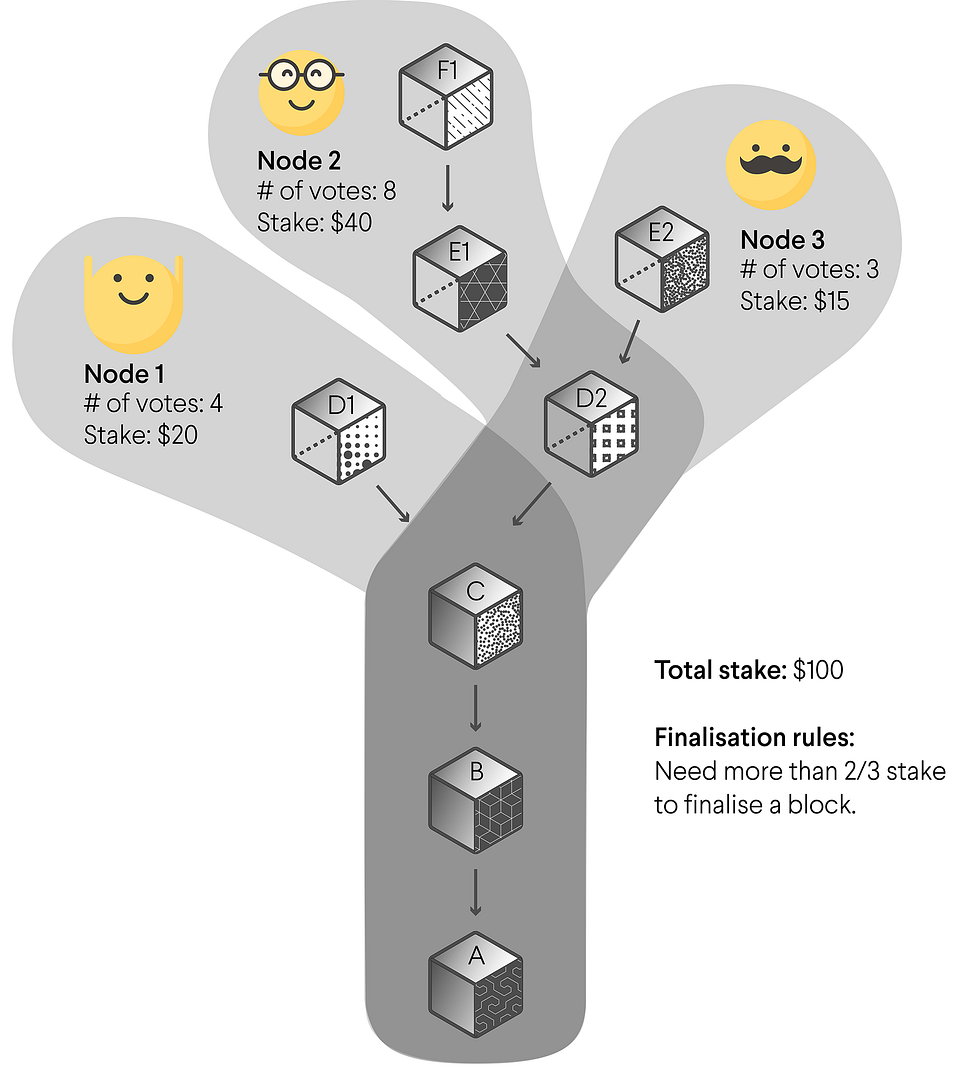
GRANDPA is our finality gadget. It allows a set of nodes to come to BFT agreement on what is the
|
||
canonical chain. It requires that 2/3 of the validator set agrees on a prefix of the canonical
|
||
chain, which then becomes finalized.
|
||
|
||
|
||
|
||
### Difficulties of GRANDPA finality proofs
|
||
|
||
```rust
|
||
struct Justification<Block: BlockT> {
|
||
round: u64,
|
||
commit: Commit<Block>,
|
||
votes_ancestries: Vec<Block::Header>,
|
||
}
|
||
|
||
struct Commit<Hash, Number, Signature, Id> {
|
||
target_hash: Hash,
|
||
target_number: Number,
|
||
precommits: Vec<SignedPrecommit<Hash, Number, Signature, Id>>,
|
||
}
|
||
|
||
struct SignedPrecommit<Hash, Number, Signature, Id> {
|
||
precommit: Precommit<Hash, Number>,
|
||
signature: Signature,
|
||
id: Id,
|
||
}
|
||
|
||
struct Precommit<Hash, Number> {
|
||
target_hash: Hash,
|
||
target_number: Number,
|
||
}
|
||
```
|
||
|
||
The main difficulty of verifying GRANDPA finality proofs comes from the fact that voters are
|
||
voting on different things. In GRANDPA each voter will vote for the block they think is the
|
||
latest one, and the protocol will come to agreement on what is the common ancestor which has >
|
||
2/3 support.
|
||
|
||
This creates two sets of inefficiencies:
|
||
|
||
- We may need to have each validator's vote data because they're all potentially different (i.e.
|
||
just the signature isn't enough).
|
||
- We may need to attach a couple of headers to the finality proof in order to be able to verify
|
||
all of the votes' ancestries.
|
||
|
||
Additionally, since our interim goal is to bridge to Ethereum there is also a difficulty related
|
||
to "incompatible" crypto schemes. We use \`ed25519\` signatures in GRANDPA which we can't
|
||
efficiently verify in the EVM.
|
||
|
||
Hence,
|
||
|
||
### Goals of BEEFY
|
||
|
||
1. Allow customisation of crypto to adapt for different targets. Support thresholds signatures as
|
||
well eventually.
|
||
1. Minimize the size of the "signed payload" and the finality proof.
|
||
1. Unify data types and use backward-compatible versioning so that the protocol can be extended
|
||
(additional payload, different crypto) without breaking existing light clients.
|
||
|
||
And since BEEFY is required to be running on top of GRANDPA. This allows us to take couple of
|
||
shortcuts:
|
||
1. BEEFY validator set is **the same** as GRANDPA's (i.e. the same bonded actors), they might be
|
||
identified by different session keys though.
|
||
1. BEEFY runs on **finalized** canonical chain, i.e. no forks (note Misbehavior
|
||
section though).
|
||
1. From a single validator perspective, BEEFY has at most one active voting round. Since GRANDPA
|
||
validators are reaching finality, we assume they are on-line and well-connected and have
|
||
similar view of the state of the blockchain.
|
||
|
||
# The BEEFY Protocol
|
||
|
||
## Mental Model
|
||
|
||
BEEFY should be considered as an extra voting round done by GRANDPA validators for the current
|
||
best finalized block. Similarly to how GRANDPA is lagging behind best produced (non-finalized)
|
||
block, BEEFY is going to lag behind best GRANDPA (finalized) block.
|
||
|
||
```
|
||
┌──────┐ ┌──────┐ ┌──────┐ ┌──────┐ ┌──────┐
|
||
│ │ │ │ │ │ │ │ │ │
|
||
│ B1 │ │ B2 │ │ B3 │ │ B4 │ │ B5 │
|
||
│ │ │ │ │ │ │ │ │ │
|
||
└──────┘ └───▲──┘ └──────┘ └───▲──┘ └───▲──┘
|
||
│ │ │
|
||
Best BEEFY block───────────────┘ │ │
|
||
│ │
|
||
Best GRANDPA block───────────────────────────────┘ │
|
||
│
|
||
Best produced block───────────────────────────────────────┘
|
||
|
||
```
|
||
|
||
A pseudo-algorithm of behaviour for a fully-synced BEEFY validator is:
|
||
|
||
```
|
||
loop {
|
||
let (best_beefy, best_grandpa) = wait_for_best_blocks();
|
||
|
||
let block_to_vote_on = choose_next_beefy_block(
|
||
best_beefy,
|
||
best_grandpa
|
||
);
|
||
|
||
let payload_to_vote_on = retrieve_payload(block_to_vote_on);
|
||
|
||
let commitment = (block_to_vote_on, payload_to_vote_on);
|
||
|
||
let signature = sign_with_current_session_key(commitment);
|
||
|
||
broadcast_vote(commitment, signature);
|
||
}
|
||
```
|
||
|
||
## Details
|
||
|
||
Before we jump into describing how BEEFY works in details, let's agree on the terms we are going
|
||
to use and actors in the system. All nodes in the network need to participate in the BEEFY
|
||
networking protocol, but we can identify two distinct actors though: **regular nodes** and
|
||
**BEEFY validators**.
|
||
Validators are expected to actively participate in the protocol, by producing and broadcasting
|
||
**votes**. Votes are simply their signatures over a **Commitment**. A Commitment consists of a
|
||
**payload** (an opaque blob of bytes extracted from a block or state at that block, expected to
|
||
be some form of crypto accumulator (like Merkle Tree Hash or Merkle Mountain Range Root Hash))
|
||
and **block number** from which this payload originates. Additionally, Commitment contains BEEFY
|
||
**validator set id** at that particular block. Note the block is finalized, so there is no
|
||
ambiguity despite using block number instead of a hash. A collection of **votes**, or rather
|
||
a Commitment and a collection of signatures is going to be called **Signed Commitment**. A valid
|
||
(see later for the rules) Signed Commitment is also called a **BEEFY Justification** or
|
||
**BEEFY Finality Proof**. For more details on the actual data structures please see
|
||
[BEEFY primitives definitions](https://github.com/paritytech/polkadot-sdk/tree/master/substrate/primitives/beefy/src).
|
||
|
||
A **round** is an attempt by BEEFY validators to produce a BEEFY Justification. **Round number**
|
||
is simply defined as a block number the validators are voting for, or to be more precise, the
|
||
Commitment for that block number. Round ends when the next round is started, which may happen
|
||
when one of the events occur:
|
||
1. Either the node collects `2/3rd + 1` valid votes for that round.
|
||
2. Or the node receives a BEEFY Justification for a block greater than the current best BEEFY block.
|
||
|
||
In both cases the node proceeds to determining the new round number using "Round Selection"
|
||
procedure.
|
||
|
||
Regular nodes are expected to:
|
||
1. Receive & validate votes for the current round and broadcast them to their peers.
|
||
1. Receive & validate BEEFY Justifications and broadcast them to their peers.
|
||
1. Return BEEFY Justifications for **Mandatory Blocks** on demand.
|
||
1. Optionally return BEEFY Justifications for non-mandatory blocks on demand.
|
||
|
||
Validators are expected to additionally:
|
||
1. Produce & broadcast vote for the current round.
|
||
|
||
Both kinds of actors are expected to fully participate in the protocol ONLY IF they believe they
|
||
are up-to-date with the rest of the network, i.e. they are fully synced. Before this happens,
|
||
the node should continue processing imported BEEFY Justifications and votes without actively
|
||
voting themselves.
|
||
|
||
### Round Selection
|
||
|
||
Every node (both regular nodes and validators) need to determine locally what they believe
|
||
current round number is. The choice is based on their knowledge of:
|
||
|
||
1. Best GRANDPA finalized block number (`best_grandpa`).
|
||
1. Best BEEFY finalized block number (`best_beefy`).
|
||
1. Starting block of current session (`session_start`).
|
||
|
||
**Session** means a period of time (or rather number of blocks) where validator set (keys) do not change.
|
||
See `pallet_session` for implementation details in `FRAME` context. Since we piggy-back on
|
||
GRANDPA, session boundaries for BEEFY are exactly the same as the ones for GRANDPA.
|
||
|
||
We define two kinds of blocks from the perspective of BEEFY protocol:
|
||
1. **Mandatory Blocks**
|
||
2. **Non-mandatory Blocks**
|
||
|
||
Mandatory blocks are the ones that MUST have BEEFY justification. That means that the validators
|
||
will always start and conclude a round at mandatory blocks. For non-mandatory blocks, there may
|
||
or may not be a justification and validators may never choose these blocks to start a round.
|
||
|
||
Every **first block in** each **session** is considered a **mandatory block**. All other blocks
|
||
in the session are non-mandatory, however validators are encouraged to finalize as many blocks as
|
||
possible to enable lower latency for light clients and hence end users. Since GRANDPA is
|
||
considering session boundary blocks as mandatory as well, `session_start` block will always have
|
||
both GRANDPA and BEEFY Justification.
|
||
|
||
Therefore, to determine current round number nodes use a formula:
|
||
|
||
```
|
||
round_number =
|
||
(1 - M) * session_start
|
||
+ M * (best_beefy + NEXT_POWER_OF_TWO((best_grandpa - best_beefy + 1) / 2))
|
||
```
|
||
|
||
where:
|
||
|
||
- `M` is `1` if mandatory block in current session is already finalized and `0` otherwise.
|
||
- `NEXT_POWER_OF_TWO(x)` returns the smallest number greater or equal to `x` that is a power of two.
|
||
|
||
In other words, the next round number should be the oldest mandatory block without a justification,
|
||
or the highest GRANDPA-finalized block, whose block number difference with `best_beefy` block is
|
||
a power of two. The mental model for round selection is to first finalize the mandatory block and
|
||
then to attempt to pick a block taking into account how fast BEEFY catches up with GRANDPA.
|
||
In case GRANDPA makes progress, but BEEFY seems to be lagging behind, validators are changing
|
||
rounds less often to increase the chance of concluding them.
|
||
|
||
As mentioned earlier, every time the node picks a new `round_number` (and validator casts a vote)
|
||
it ends the previous one, no matter if finality was reached (i.e. the round concluded) or not.
|
||
Votes for an inactive round should not be propagated.
|
||
|
||
Note that since BEEFY only votes for GRANDPA-finalized blocks, `session_start` here actually means:
|
||
"the latest session for which the start of is GRANDPA-finalized", i.e. block production might
|
||
have already progressed, but BEEFY needs to first finalize the mandatory block of the older
|
||
session.
|
||
|
||
In good networking conditions BEEFY may end up finalizing each and every block (if GRANDPA does
|
||
the same). Practically, with short block times, it's going to be rare and might be excessive, so
|
||
it's suggested for implementations to introduce a `min_delta` parameter which will limit the
|
||
frequency with which new rounds are started. The affected component of the formula would be:
|
||
`best_beefy + MAX(min_delta, NEXT_POWER_OF_TWO(...))`, so we start a new round only if the
|
||
power-of-two component is greater than the min delta. Note that if `round_number > best_grandpa`
|
||
the validators are not expected to start any round.
|
||
|
||
### Catch up
|
||
|
||
Every session is guaranteed to have at least one BEEFY-finalized block. However it also means
|
||
that the round at mandatory block must be concluded even though, a new session has already started
|
||
(i.e. the on-chain component has selected a new validator set and GRANDPA might have already
|
||
finalized the transition). In such case BEEFY must "catch up" the previous sessions and make sure to
|
||
conclude rounds for mandatory blocks. Note that older sessions must obviously be finalized by the
|
||
validator set at that point in time, not the latest/current one.
|
||
|
||
### Initial Sync
|
||
|
||
It's all rainbows and unicorns when the node is fully synced with the network. However during cold
|
||
startup it will have hard time determining the current round number. Because of that nodes that
|
||
are not fully synced should not participate in BEEFY protocol at all.
|
||
|
||
During the sync we should make sure to also fetch BEEFY justifications for all mandatory blocks.
|
||
This can happen asynchronously, but validators, before starting to vote, need to be certain
|
||
about the last session that contains a concluded round on mandatory block in order to initiate the
|
||
catch up procedure.
|
||
|
||
### Gossip
|
||
|
||
Nodes participating in BEEFY protocol are expected to gossip messages around.
|
||
The protocol defines following messages:
|
||
|
||
1. Votes for the current round,
|
||
2. BEEFY Justifications for recently concluded rounds,
|
||
3. BEEFY Justification for the latest mandatory block,
|
||
|
||
Each message is additionally associated with a **topic**, which can be either:
|
||
1. the round number (i.e. topic associated with a particular round),
|
||
2. or the global topic (independent from the rounds).
|
||
|
||
Round-specific topic should only be used to gossip the votes, other messages are gossiped
|
||
periodically on the global topic. Let's now dive into description of the messages.
|
||
|
||
- **Votes**
|
||
- Votes are sent on the round-specific topic.
|
||
- Vote is considered valid when:
|
||
- The commitment matches local commitment.
|
||
- The validator is part of the current validator set.
|
||
- The signature is correct.
|
||
|
||
- **BEEFY Justification**
|
||
- Justifications are sent on the global topic.
|
||
- Justification is considered worthwhile to gossip when:
|
||
- It is for a recent (implementation specific) round or the latest mandatory round.
|
||
- All signatures are valid and there is at least `2/3rd + 1` of them.
|
||
- Signatories are part of the current validator set.
|
||
- Mandatory justifications should be announced periodically.
|
||
|
||
## Misbehavior
|
||
|
||
Similarly to other PoS protocols, BEEFY considers casting two different votes in the same round a
|
||
misbehavior. I.e. for a particular `round_number`, the validator produces signatures for 2 different
|
||
`Commitment`s and broadcasts them. This is called **equivocation**.
|
||
|
||
On top of this, voting on an incorrect **payload** is considered a misbehavior as well, and since
|
||
we piggy-back on GRANDPA there is no ambiguity in terms of the fork validators should be voting for.
|
||
|
||
Misbehavior should be penalized. If more validators misbehave in the exact same `round` the
|
||
penalty should be more severe, up to the entire bonded stake in case we reach `1/3rd + 1`
|
||
validators misbehaving.
|
||
|
||
## Ethereum
|
||
|
||
Initial version of BEEFY was made to enable efficient bridging with Ethereum, where the light
|
||
client is a Solidity Smart Contract compiled to EVM bytecode. Hence the choice of the initial
|
||
cryptography for BEEFY: `secp256k1` and usage of `keccak256` hashing function.
|
||
|
||
### Future: Supporting multiple crypto
|
||
|
||
While BEEFY currently works with `secp256k1` signatures, we intend in the future to support
|
||
multiple signature schemes.
|
||
This means that multiple kinds of `SignedCommitment`s might exist and only together they form a
|
||
full `BEEFY Justification`.
|
||
|
||
## BEEFY Key
|
||
|
||
The current cryptographic scheme used by BEEFY is `ecdsa`. This is **different** from other
|
||
schemes like `sr25519` and `ed25519` which are commonly used in Substrate configurations for
|
||
other pallets (BABE, GRANDPA, AuRa, etc). The most noticeable difference is that an `ecdsa`
|
||
public key is `33` bytes long, instead of `32` bytes for a `sr25519` based public key. So, a
|
||
BEEFY key [sticks out](https://github.com/paritytech/polkadot/blob/25951e45b1907853f120c752aaa01631a0b3e783/node/service/src/chain_spec.rs#L738)
|
||
among the other public keys a bit.
|
||
|
||
For other crypto (using the default Substrate configuration) the `AccountId` (32-bytes) matches
|
||
the `PublicKey`, but note that it's not the case for BEEFY. As a consequence of this, you can
|
||
**not** convert the `AccountId` raw bytes into a BEEFY `PublicKey`.
|
||
|
||
The easiest way to generate or view hex-encoded or SS58-encoded BEEFY Public Key is by using the
|
||
[Subkey](https://substrate.dev/docs/en/knowledgebase/integrate/subkey) tool. Generate a BEEFY key
|
||
using the following command
|
||
|
||
```sh
|
||
subkey generate --scheme ecdsa
|
||
```
|
||
|
||
The output will look something like
|
||
|
||
```sh
|
||
Secret phrase `sunset anxiety liberty mention dwarf actress advice stove peasant olive kite rebuild` is account:
|
||
Secret seed: 0x9f844e21444683c8fcf558c4c11231a14ed9dea6f09a8cc505604368ef204a61
|
||
Public key (hex): 0x02d69740c3bbfbdbb365886c8270c4aafd17cbffb2e04ecef581e6dced5aded2cd
|
||
Public key (SS58): KW7n1vMENCBLQpbT5FWtmYWHNvEyGjSrNL4JE32mDds3xnXTf
|
||
Account ID: 0x295509ae9a9b04ade5f1756b5f58f4161cf57037b4543eac37b3b555644f6aed
|
||
SS58 Address: 5Czu5hudL79ETnQt6GAkVJHGhDQ6Qv3VWq54zN1CPKzKzYGu
|
||
|
||
```
|
||
|
||
In case your BEEFY keys are using the wrong cryptographic scheme, you will see an invalid public
|
||
key format message at node startup. Basically something like
|
||
|
||
```sh
|
||
...
|
||
2021-05-28 12:37:51 [Relaychain] Invalid BEEFY PublicKey format!
|
||
...
|
||
```
|
||
|
||
# BEEFY Light Client
|
||
|
||
TODO
|